

Your Authorization Rate Is a Revenue Strategy
Most payment optimization conversations start in the wrong place.
They focus on which gateway to use, how to reduce chargebacks, or how to stay PCI compliant. All important but they miss the metric that quietly determines how much revenue a business actually collects: the authorization rate.
Authorization rate is the percentage of attempted transactions that are successfully approved. It sounds simple. But behind that single number sits a web of card networks, issuing banks, fraud engines, authentication flows, and infrastructure decisions and each one a potential point of failure.
-
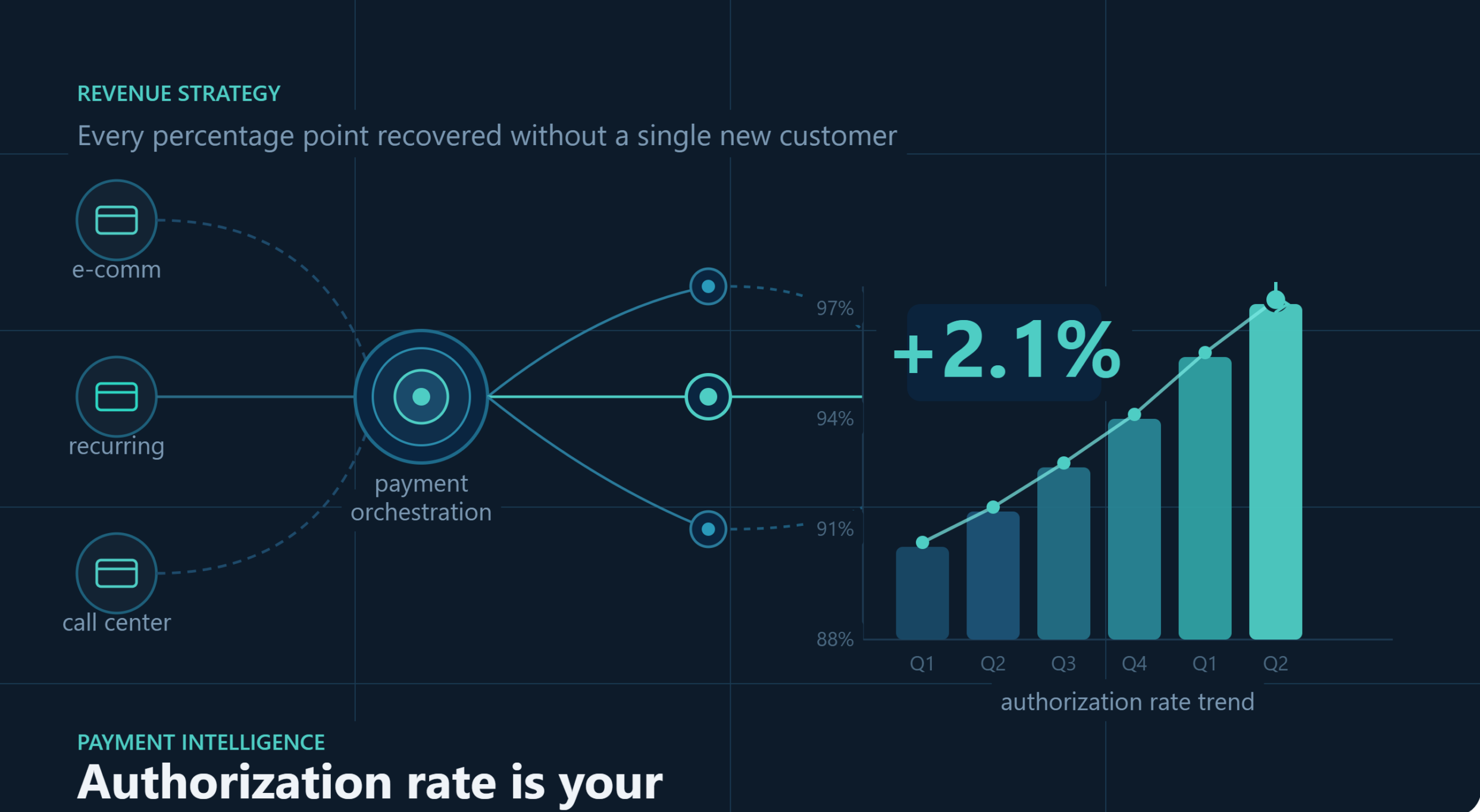
The opportunity: For many businesses, improving authorization rates by even 1–2 percentage points can generate hundreds of thousands of dollars in recovered revenue annually, without acquiring a single new customer.
This post breaks down what’s actually driving authorization rates down, why conventional payment setups leave money on the table, and what a modern payment strategy looks like for businesses serious about maximizing the revenue they’ve already earned.
Why Authorization Rates Deserve a Seat at the Strategy Table
Authorization rates rarely appear in a business’s top-line KPIs. They tend to live in the payments team, or in a report that finance glances at quarterly. But that framing understates their impact significantly.
Consider a subscription business processing 50,000 recurring transactions per month at an average value of $80. At a 92% authorization rate, they’re collecting 46,000 of those transactions. Improve that rate to 95% and they recover 1,500 additional payments which is an additional $120,000 per month, $1.44 million per year. That revenue was already earned. The customers already signed up. The services were delivered. The only thing standing between those businesses and that revenue was payment infrastructure.
For e-commerce, call centers, and B2B platforms, the math is similar. Every declined transaction that isn’t recovered is a hard loss.
The Real Reasons Payments Fail
Most payment failures get categorized as “declines” and left there. But decline codes tell very different stories, and treating them uniformly is one of the most expensive mistakes a business can make.
Stale Payment Credentials
Card data has a shelf life. Cards expire, get replaced after fraud, or are reissued when banks upgrade their infrastructure. In any recurring billing environment, a portion of stored card data is out of date at any given moment.
What makes this particularly costly is that stale credentials trigger declines that have nothing to do with a customer’s intent or ability to pay. The customer wants to keep subscribing. The card just changed. Without an automated way to refresh that data, businesses are losing revenue from their most loyal customers.
Intelligent Fraud Systems Blocking Good Transactions
Issuing banks have become significantly better at detecting fraud and that’s mostly a good thing. But the same machine learning systems that catch bad actors also produce false positives.
A transaction can be flagged because it’s slightly larger than a customer’s typical purchase, because it originates from a new device, or simply because the bank’s model scores it as borderline. From the customer’s perspective, their legitimate purchase was rejected for no apparent reason. From the business’s perspective, it looks like a standard decline.
This is why the same transaction sent through different acquiring banks, at different times, or with different authentication signals can produce different outcomes. Authorization rates are not fixed, they’re shaped by the decisions a business makes about how transactions are presented.
Authentication Friction and Abandonment
The continued rollout of 3D Secure and Strong Customer Authentication requirements has introduced a new category of failure: transactions that are abandoned, not declined.
When authentication adds friction by an unexpected redirect, an OTP that doesn’t arrive, a step-up challenge on a mobile device, some percentage of customers simply don’t complete the process. These don’t always show up as declines. They show up as abandoned carts or cancelled checkout sessions.
Proper 3DS implementation, including appropriate use of exemptions and frictionless flows for trusted transactions, can dramatically reduce this drop-off.
Processor and Gateway Failures
Not all payment failures originate with the customer or their bank. Gateways go down. Processors experience degraded performance. Acquiring banks have regional outages. When a business routes all transactions through a single provider, any disruption in that provider’s infrastructure becomes a disruption to every transaction.
This category of failure is often the most invisible because when the gateway returns a generic error, it can look like a card decline in reporting dashboards.
Poorly Timed Retry Attempts
For recurring billing, when a transaction is retried matters as much as how it’s retried. Retrying a failed transaction at the same time of day, on the same day of the month, through the same processor, is likely to produce the same result.
Smart retry strategies incorporate timing based on decline reason, card type, and historical recovery patterns recovering transactions that a static retry cadence would leave behind.
What a Modern Payment Strategy Actually Looks Like
The businesses consistently achieving authorization rates above industry averages aren’t doing one thing differently, they’re approaching payments as an interconnected system, not a commodity service.
Automated Account Updating
Card networks including Visa and Mastercard operate account updater services that distribute new card details to merchants when a card is replaced or reissued. Integrating with these services automatically keeps stored payment credentials current, dramatically reducing the volume of declines tied to stale card data.
For businesses with large stored-credential databases and subscription platforms, payment facilitators, call centers, this is one of the highest-return investments available.
Intelligent Payment Routing
Payment orchestration platforms allow businesses to maintain relationships with multiple payment processors and route transactions dynamically based on transaction type, geography, card type, or real-time processor performance.
The practical impact: if one processor is underperforming on a particular card network, transactions can be routed to an alternate processor with better network relationships. If a processor experiences an outage, transactions fail over automatically rather than failing entirely.
This isn’t infrastructure complexity for its own sake, it’s resilience that translates directly into revenue.
Decline-Aware Retry Logic
Different decline codes call for different responses. A soft decline due to insufficient funds might succeed if retried a few days later, closer to a customer’s pay cycle. A hard decline on a flagged card should not be retried and should instead trigger an update request to the customer.
Building retry logic that accounts for decline reason, card type, historical recovery rates by day of week, and customer segment can significantly improve recovery rates compared to a static retry cadence.
3DS Optimization and Exemption Management
Strong Customer Authentication requirements are here to stay in most markets, and expand in others. But within those requirements, there’s significant latitude in how authentication is implemented.
Transaction risk analysis (TRA) exemptions allow low-risk transactions to flow through frictionless authentication. Merchant-initiated transaction flags can bypass step-up challenges on recurring payments. Properly implemented, 3DS becomes a tool that improves security without degrading the customer experience or suppressing authorization rates.
Secure Tokenization and Vault Architecture
Securely storing and managing payment credentials is foundational to every other payment optimization strategy. A flexible, processor-agnostic vault allows businesses to switch processors, add redundancy, and implement account updating without disrupting stored customer payment data.
It’s also the infrastructure layer that makes smart retry logic and payment routing possible because without reliable access to payment credentials, none of the downstream optimization matters.
The Business Case for Payment Infrastructure Investment
There’s a persistent tendency to treat payment infrastructure as a cost center, something to be minimized, not optimized. That framing gets the incentives exactly backwards.
Every dollar invested in account updating, intelligent routing, retry optimization, and authentication configuration has a direct, measurable return in recovered revenue. Unlike customer acquisition, which is speculative, payment optimization recovers revenue from customers who have already demonstrated intent to pay.
The businesses that have moved payment strategy from the back office to the boardroom are the ones that have recognized this dynamic. They’ve built payment teams with dedicated focus on authorization rates. They’ve invested in orchestration layers that give them flexibility and resilience. And they’ve stopped treating payment declines as an inevitable fact of life.
- The bottom line: Payment failures are a leaky bucket. You can keep filling it with new customers, or you can fix the leaks. The most effective payment strategies do both.
Key Takeaways
- Authorization rate is one of the highest-leverage metrics in payments and small improvements compound into significant revenue recovery
- Most payment failures have identifiable causes: stale credentials, fraud false positives, authentication friction, processor issues, and poorly timed retries
- Account updater services, intelligent routing, decline-aware retry logic, and 3DS optimization each address different failure categories
- Payment infrastructure is not a cost center and is a revenue recovery function
- The businesses achieving the highest authorization rates treat payments as a system to be optimized, not a commodity to be minimized
Ready to audit your authorization rate?
Understanding where your payments are failing is the first step to recovering the revenue you’ve already earned. Whether you’re dealing with recurring billing challenges, gateway redundancy, or authentication optimization, there’s almost always room to improve.
Explore how our payment solutions help businesses increase authorization rates, reduce involuntary churn, and build the infrastructure for sustainable revenue growth.
Learn more at www.HostedPCI.com.