
The State of Modern Payments: Why Payment Infrastructure Is Becoming a Competitive Advantage
Payment Infrastructure Is Now a Competitive Advantage. Most Businesses Haven’t Noticed Yet.
For most of the last two decades, payments worked like plumbing. You hired someone to install it, you made sure it didn’t leak, and you mostly forgot about it. That era is over. The businesses outperforming their competitors today, whether measured by authorization rates, customer retention, operational resilience, or readiness for new payment channels, aren’t winning because they found a cheaper processor. They’re winning because they made a different decision about infrastructure. They decided that how payment data is collected, stored, routed, and controlled isn’t a back-office detail. It’s a strategic asset. Most companies haven’t made that decision yet. What follows explains why it matters, and what modern payment infrastructure actually looks like when it’s built to drive business outcomes rather than just process transactions.
Gateway Lock-In: The Hidden Cost of Modern Payments
Ask almost any payments leader what their biggest operational headache is, and eventually the conversation turns to the same problem: they can’t move. Their business has grown. Their transaction volumes have changed. A better-priced processor has entered their market. Or they’ve been acquired, and the new parent company uses a different gateway. And yet, switching feels nearly impossible. This isn’t an accident. It’s the result of a specific architectural decision made years earlier, often without realizing its long-term implications: they let their processor own their payment data. Most major processors issue processor tokens. These secure references replace raw cardholder data, but they only function within their own ecosystem. The token your processor issues today is meaningless to a different processor tomorrow. That means your customer payment data, stored credentials, and recurring billing relationships are effectively held hostage.
Processor tokens vs. merchant-owned tokens
This distinction is one of the most important in modern payments, and one of the least discussed. A processor token lives in your processor’s vault. It works great as long as you stay with that processor. The moment you want to migrate, you’re either re-tokenizing every card on file (which means asking customers to re-enter their payment details), negotiating a complex data migration that may or may not be supported, or simply staying where you are and accepting terms you’d otherwise walk away from. By contrast, a merchant-owned token lives in a payment vault that you control. It remains portable across supported gateways and processors. Your token remains valid regardless of which processor you’re routing to. Migrations become planned projects instead of crises. Processor negotiations happen on your terms. For any business with a significant base of stored payment credentials, such as subscription services, marketplaces, healthcare providers, or enterprise SaaS companies, merchant-owned tokenization isn’t a luxury feature. It’s a foundational decision that shapes every payment relationship you’ll have for years.
Authorization Rate Optimization: The Revenue Lever Most Companies Ignore
Authorization rate optimization deserves its own treatment and we’ve covered it in depth here. But in the context of infrastructure, the core point is this: every element of modern payment architecture described in this article, including intelligent routing, multi-processor support, retry logic, and account updater services, has a direct effect on how many of your transactions succeed. Infrastructure isn’t just a cost and compliance story. It’s a revenue story.
How Modern Payment Infrastructure Improves Authorization Rates
Authorization rates aren’t determined solely by the issuing bank. The technology decisions made throughout your payment infrastructure have a direct and measurable influence on how many transactions succeed. When a transaction is routed to the processor best suited to approve it, based on card type, issuing bank, geography, or transaction history, approval rates improve. When a failed transaction is automatically retried through an alternative processor before returning a decline, revenue is recovered that would otherwise be lost. When stored card credentials are automatically refreshed through account updater services, the silent churn caused by expired cards is reduced. When network tokens replace static card numbers, transactions carry stronger authentication signals that issuers trust. None of these improvements require acquiring new customers or renegotiating processor fees. They are the direct result of building payment infrastructure that’s designed to optimize payment performance, not simply process transactions. For most businesses, this represents one of the largest untapped revenue opportunities in their payment stack. Learn more about authorization rate optimization and what it means for your business.
Payment Orchestration: What It Is and Why It Changes Everything
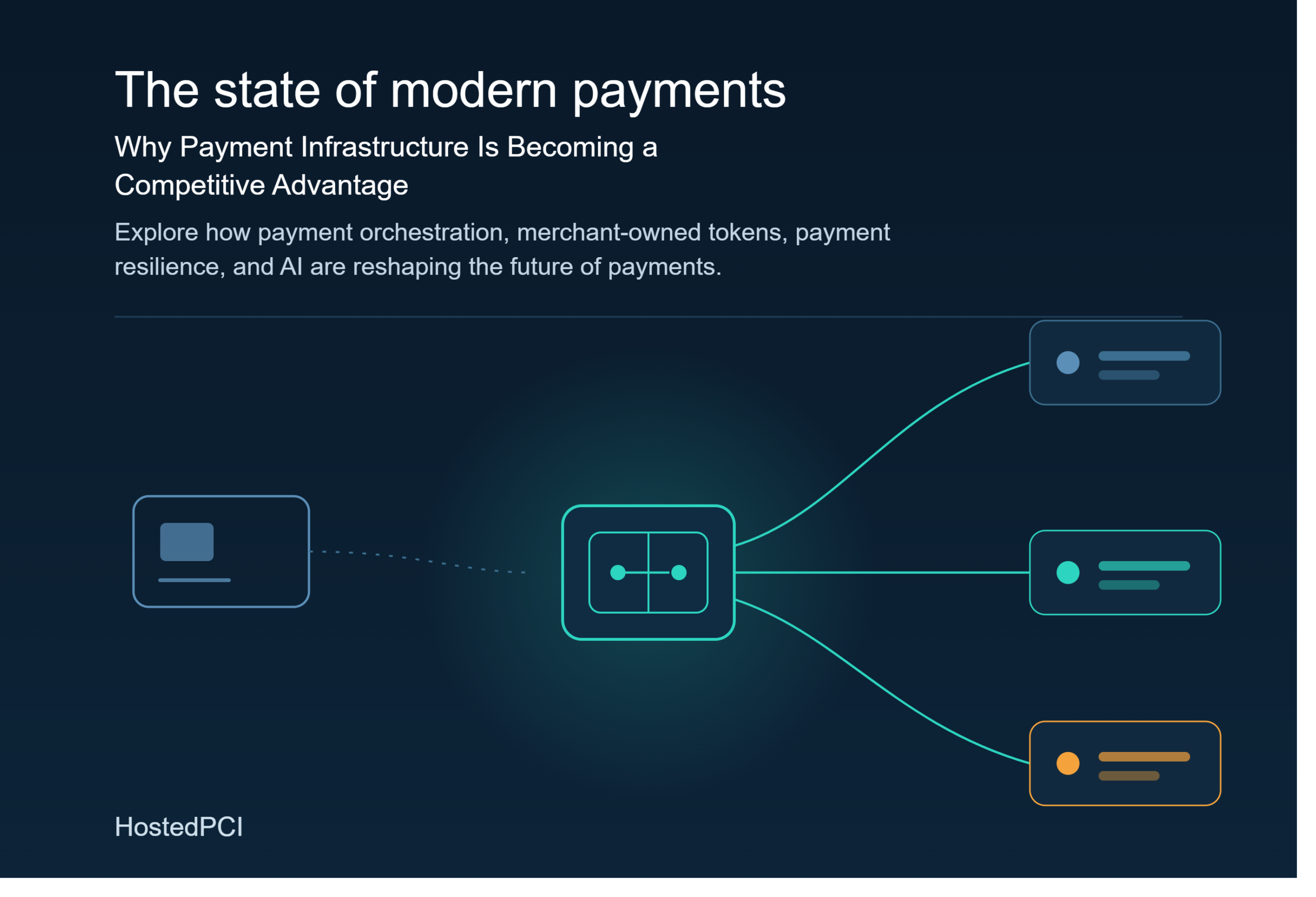
The term “payment orchestration” has become something of a buzzword, which has made it easy to dismiss. That would be a mistake. Payment orchestration is the technology layer that connects your business to processors, gateways, fraud tools, and alternative payment methods while managing how transactions flow between them. Without orchestration, changing anything about your payment stack means rebuilding integrations. Adding a processor for a new market requires months of development. Testing whether a different gateway improves authorization rates for a specific card type is an engineering project. Failing over to a backup processor during an outage requires manual intervention, if it’s possible at all. With orchestration, these become configuration decisions rather than development projects. More importantly, orchestration changes the strategic position of your business relative to your payment providers. Instead of being dependent on a single processor’s uptime, pricing, and feature roadmap, you’re running a payment environment where providers compete for your transaction flow. That’s a fundamentally different negotiating posture. This is why payment orchestration has become a prerequisite for serious payment infrastructure modernization not because it’s technically impressive, but because it makes every other payment improvement easier and more sustainable.
Owning Your Payment Data: Why It Matters More Than You Think
Payment data ownership sits at the intersection of compliance, security, and business strategy. It’s worth unpacking each dimension.
The compliance dimension
PCI DSS (Payment Card Industry Data Security Standard) governs how businesses handle cardholder data. The scope of your compliance obligations is directly tied to how much cardholder data your infrastructure touches. Modern payment security technologies, including hosted payment fields, secure payment iframes (PCI iframe), and PCI-compliant IVR solutions are designed to take your systems out of scope for PCI compliance by handling the collection and transmission of sensitive data in a controlled, certified environment. A PCI-compliant iframe, for example, embeds a payment form hosted on a certified infrastructure provider’s servers directly into your checkout experience. The customer sees your branding. The card data never touches your environment. Your PCI scope shrinks dramatically. The same principle applies to call centers. A PCI-compliant IVR solution allows customers to enter payment information via their phone keypad, with the audio and data stream handled in a certified environment, meaning your call center agents never hear or see cardholder data. For businesses in healthcare, financial services, or any regulated industry handling payments over the phone, this isn’t optional. It’s the architecture. See how PCI-compliant IVR works in practice.
The business strategy dimension
Beyond compliance, payment data ownership determines your options. Who holds your tokenized cardholder data determines who you can route to, what you can negotiate, and how quickly you can adapt. A payment vault that you control, rather than one operated by your processor, means your customer data is an asset you own rather than a dependency you’ve inherited. This becomes particularly visible during payment gateway migration. Businesses built on merchant-owned tokenization can migrate processors with relatively limited disruption. Businesses that built on processor-issued tokens often discover that migrating is prohibitively complex, and may delay or abandon modernization projects as a result. The technical decisions made during implementation, including who owns your payment vault and how payment data is managed, have long-term strategic consequences that many businesses don’t recognize until they’re already locked in. Understanding the real cost of gateway lock-in starts here.
PCI Compliance as Infrastructure, Not a Yearly Project
Most businesses treat PCI compliance as an annual event: gather documentation, complete the SAQ, remediate findings, file attestation, repeat next year. That approach is increasingly misaligned with how modern businesses operate. Payment touchpoints have multiplied. Customers pay through websites, mobile apps, call centers, SMS, subscription portals, and increasingly through AI-powered agents and voice assistants. Each new payment channel is a potential compliance exposure if it’s not designed correctly from the start. The more effective approach is to build compliance into the payment infrastructure itself, rather than auditing your way into it once a year. Technologies like tokenization, secure hosted payment pages, PCI iframes, and PCI-compliant IVR exist precisely for this purpose. They reduce your exposure to cardholder data at the architectural level, so your compliance posture improves as a byproduct of better infrastructure rather than as a separate compliance program layered on top. For businesses in healthcare payments, financial services, or any sector handling significant phone-based payment volume, this architectural approach also has direct operational benefits: agents who never hear cardholder data can’t expose it, and systems that never store raw card numbers can’t lose them.
Resilience: What Happens When Your Processor Goes Down
Every payment provider experiences outages eventually. Processor outages, gateway maintenance windows, network disruptions, and regional failures are not hypothetical risks. Every payment infrastructure eventually faces them. The question is whether you’ve designed for it. Businesses relying on a single processor have a single point of failure. When that processor has an incident, transactions fail. Revenue stops. Customer experience degrades. There’s no mitigation path available in real time. Modern payment infrastructure is designed around redundancy. With multi-gateway support and intelligent failover routing, a transaction that fails at one processor can be automatically rerouted to a secondary processor in milliseconds, often without the customer ever knowing an issue occurred. For businesses processing high transaction volumes, the math is straightforward. An hour of downtime at meaningful transaction rates can represent significant lost revenue. The cost of building resilience into your payment infrastructure is almost always lower than the cost of a single major outage. Resilience isn’t a premium feature. For any business where payments are critical to operations, which includes most businesses, it’s a baseline architectural requirement.
The Coming Shift: AI, Voice, and Payments
If you’re thinking about payment infrastructure for the next five years rather than just the next twelve months, one development deserves particular attention. AI-powered customer interactions are moving from experimental to mainstream. Businesses are deploying AI agents to handle customer service, sales, and increasingly, transactions. Voice assistants are becoming a legitimate payment channel for certain customer segments. Automated commerce, where AI systems initiate purchases on behalf of users, is an emerging reality. Each of these creates a new payment surface that needs to be secured, compliant, and integrated into your existing infrastructure. The businesses that will navigate this transition most smoothly are the ones built on flexible infrastructure, including merchant-owned tokens that work across payment channels, orchestration layers that can incorporate new endpoints, compliance frameworks built into the architecture rather than bolted on. The businesses that will struggle are the ones still tied to a single processor’s ecosystem, where adding a new payment channel means negotiating capabilities with a vendor who has no particular incentive to move quickly. Payment infrastructure decisions made today will determine how easily you can adapt to payment channels that don’t fully exist yet. See how AI call centers and PCI compliance intersect.
Why Payment Infrastructure Has Become a Competitive Advantage
Payment infrastructure has always been important. The difference now is that the gap between businesses that treat it strategically and businesses that treat it operationally is becoming measurable in revenue, resilience, and competitive position. The question isn’t whether to modernize. It’s whether to do it before the pressure forces you to, or after. Businesses that have inherited processor lock-in, point-solution compliance, and single-gateway dependencies will eventually have to address them. The ones that do it proactively, on their own terms, will come out ahead. The ones that wait until a processor outage, a compliance finding, or a failed migration forces the conversation will wish they’d started earlier.
Is Your Payment Infrastructure Ready for What’s Next?
If you’re evaluating your payment strategy, planning a gateway migration, working to improve authorization rates, or looking to reduce PCI scope without sacrificing flexibility, the first step is understanding where your current payment infrastructure creates risk and where it creates opportunity.
HostedPCI helps businesses build payment infrastructure that’s flexible, resilient, and designed to evolve as business needs change.
Talk to our team about building a payment infrastructure that supports your business today and prepares you for what’s next.
Learn more at www.HostedPCI.com.