

Enterprise 3DS Customization: Why Businesses Need More Control Over Payment Authentication
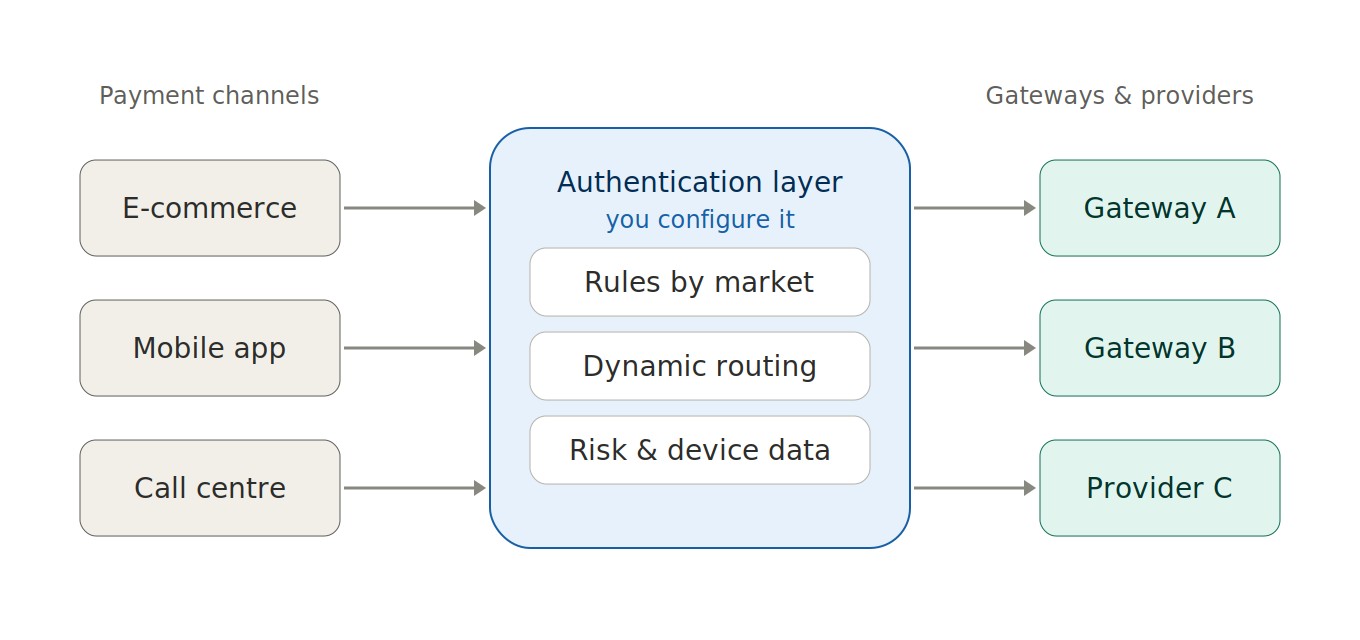
Enterprise 3DS customization gives large businesses control over when payment authentication is requested, how transaction data is submitted, which provider handles it, and how it fits into the payment journey.
For many companies, 3D Secure is treated as a simple on or off switch. For enterprises operating across multiple markets, gateways, and payment channels, that single switch is rarely enough.
The strategy that works for one transaction can create unnecessary friction, technical limitations, or routing problems for another. Enterprise 3D Secure is better treated as a configurable part of the payment architecture: an authentication layer the business controls rather than a feature it inherits from one gateway.
When implemented effectively, 3DS customization gives enterprise teams more control over fraud prevention, customer experience, payment routing, and long-term infrastructure decisions.
Key Takeaway
- Enterprise 3DS customization turns 3D Secure from a fixed gateway feature into a configurable authentication layer.
- It allows businesses to apply different rules by market, currency, channel, transaction type, and risk profile.
- Separating authentication from authorization enables multi-gateway 3DS and more flexible payment routing.
- Dynamic 3DS routing and multiple providers can improve fraud control and payment resilience.
What Is 3D Secure?
3D Secure, commonly called 3DS, is an authentication protocol that helps confirm an online card payment is being made by the legitimate cardholder.
The current EMV 3-D Secure framework allows the merchant, card issuer, and other parties involved in the transaction to exchange payment and device data during the authentication process.
Based on that data, the issuer may approve authentication without asking the customer to complete an extra step. This is known as a frictionless flow. For other transactions, the issuer may ask the customer to complete a challenge, such as confirming the payment in a banking application or entering a one-time code.
The goal is to strengthen card-not-present payment security while avoiding unnecessary interruptions for legitimate customers. However, the results depend heavily on how 3DS is implemented.
Standard 3DS vs. Enterprise 3DS Customization
Many payment providers offer 3DS as part of a standard gateway integration. That may be enough for a business with one checkout, one gateway, and a simple payment environment.
Enterprises usually require more flexibility.
They may need:
- Multiple 3DS providers instead of one provider tied to a gateway
- Configurable rules by market, currency, channel, or transaction type
- Authentication that can be separated from authorization
- Alternate authentication paths where supported
- A consistent customer experience across several gateways
- Support for recurring and credential-on-file payments
When 3DS is controlled entirely by one gateway, the merchant has limited influence over how authentication is initiated or where it is processed.
The business technically has 3DS, but it does not have meaningful control over its 3DS strategy
What Does 3DS Customization Mean?
3DS customization means controlling how authentication fits into the payment environment.
It does not mean bypassing card-network, issuer, or regulatory requirements. The issuer still determines whether a transaction qualifies for frictionless authentication or requires a customer challenge.
What changes is the merchant side of the process.
Depending on the business and supported integrations, a customized 3DS setup can allow an enterprise to:
- Decide when a transaction should go through 3DS
- Apply different rules by region, currency, channel, or transaction type
- Route authentication to different 3DS providers
- Work across more than one payment gateway
- Separate authentication from authorization
- Use authentication results in later payment-routing decisions
- Adapt the strategy as markets, providers, and requirements change
This turns 3DS from a fixed gateway feature into a configurable authentication layer that can support a broader payment-orchestration strategy.
Why Enterprise Businesses Need Control Over 3DS
1. Different Markets Need Different Strategies
A global merchant must account for regional regulations, issuer behaviour, local acquiring relationships, and differences in customer expectations.
One authentication strategy may work well in Europe but create unnecessary friction in North America. Other markets may require different providers, data fields, or routing rules.
A customizable enterprise 3D Secure setup allows the business to support different configurations by market without rebuilding the entire payment experience for every region.
2. Not Every Transaction Carries the Same Risk
A returning customer using a known device does not present the same risk as a high-value order placed from a new device.
A low-value retail purchase also differs from a large business-to-business transaction or the setup of a recurring payment agreement.
Risk-based authentication allows the business to use its own fraud tools, customer history, device information, and internal business rules to shape the authentication strategy instead of forcing every transaction through the same path.
3. Authentication Should Not Be Locked to One Gateway
When authentication and authorization are bundled together, changing one part of the payment stack can affect the entire transaction flow.
An enterprise may want to authenticate through one 3DS provider but send the payment authorization to another gateway or processor.
It may also want to change the authorization destination based on market, currency, card type, cost, or internal business rules.
Separating authentication from authorization gives the business greater routing flexibility and reduces dependence on one gateway.
Is your 3DS strategy tied to one gateway? Talk to HostedPCI about building an authentication layer your business can control.
4. Multiple Providers Can Improve Resilience
A single authentication path can become a single point of failure.
Enterprise payment systems must account for provider outages, regional restrictions, technical failures, and changing business relationships.
A configurable environment makes it easier to support multiple 3DS providers or authentication routes. If one provider becomes unavailable, another approved path may be available where supported.
This is not only a fraud-management concern. It is also a business-continuity concern.
5. Better Data Supports Better Decisions
EMV 3DS allows transaction, customer, merchant, and device information to support issuer risk analysis.
The quality of that data matters.
Enterprise teams should consider:
- What transaction data is available
- Whether the information is being passed correctly
- Whether data is formatted consistently
- Whether recurring and credential-on-file indicators are accurate
- How authentication results are stored and used
- Whether the process reflects the customer’s actual payment journey
A technically active 3DS integration is not necessarily an optimized one.
Custom 3DS and the Customer Experience
One of the most common concerns about 3DS is customer friction.
Businesses may worry that authentication will interrupt checkout, increase abandonment, or create an inconsistent experience across devices.
Modern 3DS supports risk-based authentication and frictionless flows. However, no merchant can guarantee that a transaction will be frictionless. That decision belongs to the card issuer.
What the merchant can control is the quality of the implementation.
A strong enterprise 3DS setup can help the business:
- Present authentication challenges correctly when required
- Maintain consistent branding and messaging where supported
- Avoid unnecessary interruptions in the checkout journey
- Pass useful transaction data into the authentication process
- Handle authentication outcomes correctly
- Prevent duplicated or conflicting authentication flows
- Support browser, mobile, and alternative payment journeys
The objective is not to remove authentication. It is to integrate authentication into the customer journey as cleanly as possible.
Dynamic 3DS Provider Selection
Dynamic 3DS provider selection is one of the most valuable capabilities for a complex enterprise.
Instead of sending every transaction to the same provider, the business can use transaction data to choose the appropriate authentication route.
Provider selection may be based on:
- Card BIN information
- Country or region
- Currency
- Payment gateway
- Acquirer
- Brand or business unit
- Website or application
- Transaction type
- Internal routing rules
This is useful when an enterprise works with several acquiring relationships or when certain providers are better suited to specific markets or parts of the business.
Dynamic 3DS routing also supports a more modular payment architecture. The enterprise can change or expand its authentication strategy without rebuilding every checkout integration.
3DS for Recurring and Credential-on-File Payments
Recurring billing creates additional authentication considerations.
The initial transaction or payment agreement may require customer authentication, while later merchant-initiated transactions follow a different flow.
The indicators submitted during these processes matter. Correct recurring and credential-on-file information helps issuers evaluate each transaction appropriately.
Treating every recurring transaction like a new e-commerce purchase can result in incorrect indicators, unnecessary friction, or inconsistent payment results.
Enterprise 3DS flows may need to support:
- Initial customer authentication
- Recurring payment agreements
- Fixed or variable billing amounts
- Instalment payments
- Credential-on-file transactions
- Changes to stored payment credentials
- Account updates and customer reactivation
These payment journeys should be designed carefully as part of the broader authentication strategy.
3DS Across E-Commerce and Assisted Payment Channels
Enterprise payment journeys do not always begin and end on a traditional checkout page.
A customer may begin a transaction with a call-centre agent, receive a secure payment link by SMS, enter card details on a hosted payment page, and complete an issuer challenge on a mobile device.
The business may also support:
- Initial customer authentication
- E-commerce checkout
- Mobile applications
- Customer service portals
- Secure payment links
- Call-centre payment flows
- Account-management pages
- Subscription enrolment
- Pay-by-link invoices
A customizable 3DS layer helps maintain a consistent authentication strategy across these channels.
This becomes particularly important when several systems, vendors, and internal teams participate in the same payment journey.
How HostedPCI Supports Enterprise 3DS Control
HostedPCI helps businesses incorporate 3D Secure into a flexible payment architecture without forcing the entire authentication and payment strategy into one gateway relationship. Depending on the enterprise’s requirements and supported integrations, HostedPCI can help businesses:
- Support configurable authentication flows
- Integrate 3DS into hosted payment and card-entry experiences
- Select a 3DS provider dynamically using transaction information
- Route authentication and payment data to supported providers
- Maintain flexibility across multiple gateways
- Use authentication as part of a broader payment-orchestration strategy
- Reduce direct exposure to cardholder data through hosted payment collection and tokenization
HostedPCI’s approach is based on a simple principle: enterprise payment environments require flexibility and control, not a fixed, one-size-fits-all flow.
Businesses retain greater influence over their payment infrastructure while continuing to work with the gateways, processors, fraud tools, and authentication providers that meet their needs.
Questions to Ask About Your Current 3DS Integration
Enterprise payment teams should evaluate more than whether a provider simply supports 3DS.
Useful questions include:
- 1. Can we control when and how 3DS is requested?
- 2. Is our 3DS provider tied to our payment gateway?
- 3. Can we support more than one authentication provider?
- 4. Can routing rules change by market, card, currency, or transaction type?
- 5. What happens if the authentication provider becomes unavailable?
- 6. Can our setup support recurring and credential-on-file payments?
If the answers depend entirely on one gateway’s standard configuration, the organization may have less control than it realizes.
Frequently asked questions
What is enterprise 3DS customization?
Enterprise 3DS customization is the ability to configure how 3D Secure authentication is applied across a complex payment environment.
It gives businesses control over when authentication is triggered, which provider handles it, what data is submitted, and how the authentication result flows into payment routing.
How is custom 3D Secure different from standard gateway 3DS?
Standard gateway 3DS is often a single on or off setting connected to one provider.
Custom 3D Secure allows an enterprise to apply different rules by market, currency, channel, or transaction type, use more than one provider, separate authentication from authorization, and maintain greater flexibility when changing gateways.
Does 3DS customization allow businesses to avoid customer challenges?
No.
The card issuer determines whether a transaction qualifies for a frictionless flow or requires a customer challenge.
Customization improves the merchant side of the process by helping the business submit accurate data, present challenges correctly, and handle authentication outcomes consistently.
What is dynamic 3DS routing?
Dynamic 3DS routing, also called dynamic provider selection, sends each transaction to an appropriate authentication provider based on information such as card BIN, country, currency, acquirer, gateway, or business unit.
This gives the enterprise more control than sending every transaction through the same provider.
Can 3DS work across multiple payment gateways?
Yes.
A multi-gateway 3DS setup can separate authentication from authorization, allowing the business to authenticate through one provider and route payment authorization to different gateways based on market, currency, cost, availability, or internal business rules.
3DS Should Be Part of the Payment Strategy
For enterprise businesses, 3D Secure is no longer simply a security screen added to checkout.
It is part of the broader payment architecture and can affect fraud exposure, customer experience, regulatory alignment, payment routing, resilience, and the organization’s ability to adapt over time.
A customizable 3DS strategy gives enterprises more control over those outcomes.
Instead of accepting a fixed authentication flow, businesses can build a model around their markets, customers, channels, risk rules, and payment relationships.
HostedPCI helps enterprise businesses implement secure, flexible 3DS authentication while maintaining control over how payment data and transactions move through their environment.
Learn more at www.HostedPCI.com.