
PII Tokenization for AI: How to Protect Sensitive Customer Data
Your AI does not need your customers’ raw personal data.
Businesses are moving quickly to connect artificial intelligence to customer service platforms, CRMs, healthcare systems, financial records, internal databases and automated workflows. These connections can make AI more useful, but they can also give AI systems access to far more sensitive information than they require to complete a task.
The privacy risk is no longer limited to an employee entering information into a public chatbot. AI agents can search connected systems, retrieve records, call external services and retain context across multiple steps. When those workflows contain personally identifiable information, or PII, every new connection can become another place where raw customer data is processed, copied or stored.
A 2026 enterprise AI usage study from LayerX found that 6.48% of enterprise AI conversations contained sensitive data. NTT DATA also reported that nearly 60% of AI leaders consider cross-border data restrictions a major challenge. These findings point to the same problem: businesses want the value of AI, but many of their data environments were not designed to provide AI with controlled, privacy-conscious access.
PII tokenization offers a practical way to reduce that exposure. It allows an organization to preserve the business value of a customer record while keeping the underlying identity protected in a secure vault.
Why AI agents create a different PII risk
Traditional software usually accesses information through defined screens, permissions and API calls. AI agents can operate differently. Depending on how they are configured, they may search across several systems, combine information from different sources and send data to external models or services as part of a single task.
That creates several questions businesses need to answer before connecting customer data to AI:
- What information can the AI system access?
- Does the AI actually need the customer’s identity to perform the task?
- Does the AI actually need the customer’s identity to perform the task?
- Can the provider use submitted information to improve or train its models?
- Does the information move across countries or regulatory jurisdictions?
- Who can retrieve the original information after it has been processed?
These are architecture questions, not simply policy questions. A company can tell employees not to expose customer information, but that policy will not protect a workflow that was intentionally built to send raw PII to multiple connected systems.
AI often needs context, not identity
Many AI tasks depend on the relationships and context contained in a record, not the actual identity of the individual. An AI system may need to know that several support requests belong to the same customer, for example, but it may not need that person’s name, government identifier or bank account number.
The same principle applies across several business processes:
- A customer-service assistant can categorize a support case without receiving the customer’s government identification number.
- A healthcare workflow may route a billing issue using a tokenized patient identifier rather than a raw health identifier.
- A lending system may analyze an application stage without exposing the applicant’s bank account details to an external AI service.
- Can the provider use submitted information to improve or train its models?
- Does the information move across countries or regulatory jurisdictions?
- An operations platform may group records belonging to the same person using a consistent token instead of a name or account number
This is the central idea behind PII tokenization for AI: give the downstream system the information it needs to complete the approved task, while withholding the sensitive values it does not need
What is PII tokenization?
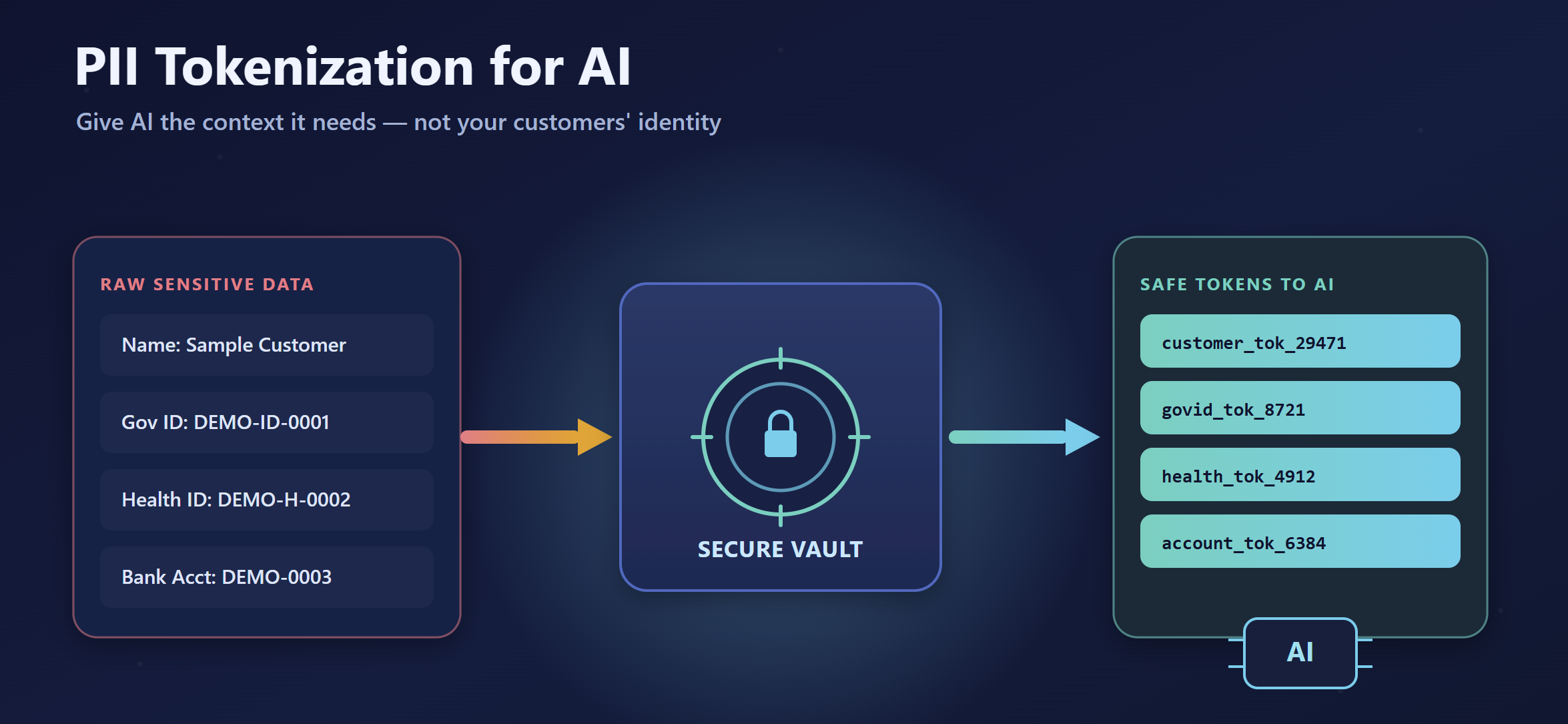
PII tokenization replaces a sensitive value with a non-sensitive substitute called a token. The original value is stored separately in a secure vault, while applications use the token in its place.
A simplified customer record might look like this:
| Sensitive field held in the vault | Value used by the AI workflow |
|---|---|
| Customer name: Sample Customer | customer_tok_29471 |
| Government ID: DEMO-ID-0001 | govid_tok_8721 |
| Health identifier: DEMO-H-0002 | health_tok_4912 |
| Bank account: DEMO-ACCT-0003 | account_tok_6384 |
Illustrative example only. All values and tokens shown above are fictional.
The token can preserve the connection between records without exposing the original information. If the workflow later requires the real value for an authorized business purpose, the original data can be securely retrieved or delivered through a controlled process.
Tokenization does not eliminate every privacy obligation, and it does not make an AI system automatically compliant. It reduces the amount of raw personal information circulating through applications and integrations, which can make the overall data flow easier to control and secure.
How tokenization can protect a controlled AI workflow
A tokenized AI workflow can be designed around five basic steps:
- 1. Collect the sensitive information through an approved, secure data-collection flow.
- 2. Send the identified sensitive fields to a tokenization service and store the original values in a secure vault.
- 3. Return non-sensitive tokens to the organization’s applications and databases.
- 4. Provide the AI system or third-party service with the tokens and other approved, non-sensitive information.
- 5. Retrieve or securely forward the original value only when an authorized downstream process genuinely requires it.
The most effective version of this architecture tokenizes sensitive information as early as possible. If the organization waits until raw PII has already passed through application databases, logs and several integrations, much of the exposure has already occurred.
Why blocking AI is not a complete strategy
Organizations need policies governing which AI tools employees may use and what information may be entered into them. Some businesses will also need monitoring, access controls and data-loss-prevention technology. Those measures address unauthorized or accidental activity.
However, blocking public tools does not solve the architectural question of how approved AI systems should interact with customer data. Businesses are still building customer-service agents, automated claims processes, financial workflows and internal assistants that require controlled access to business records.
A stronger strategy combines several layers:
- AI-use policies and employee education
- Approved enterprise AI accounts and identity controls
- Data discovery and classification
- Monitoring and data-loss-prevention controls where appropriate
- PII tokenization and secure vaulting for controlled workflows
- Clear authorization rules for retrieval and detokenization
- Vendor, retention and data-residency reviews
Tokenization is one part of that strategy, but it addresses an important problem: reducing how often raw personal data must leave the secure system responsible for protecting it.
Data residency is becoming an AI architecture decision
AI services may process information in different regions, rely on several infrastructure providers or send data between connected systems. That makes it important to understand not only where a model operates, but also where prompts, files, logs, embeddings, backups and original customer records are stored.
NTT DATA’s 2026 research found that nearly 60% of AI leaders view cross-border data restrictions as a major challenge. The report describes jurisdiction as an architectural constraint for modern AI because sensitive information cannot always move as freely as AI systems expect.
Choosing where original PII is stored can help a business design its AI workflow around regional and contractual requirements. Data residency alone does not guarantee compliance, but it is an increasingly important part of privacy-by-design.
Questions to ask before connecting customer PII to AI
Before giving an AI model or agent access to customer information, businesses should document the answers to the following questions:
- What exact task is the AI expected to perform?
- Which individual data fields are truly required for that task?
- Can names, account details, health identifiers or government IDs be replaced with tokens?
- Will the provider retain prompts, files, outputs or logs?
- Can submitted data be used for model training or product improvement?
- Where will the data be processed, stored and backed up?
- Which employees, systems and vendors can retrieve the original values?
- Are access, delivery and detokenization events recorded?
- How will information be corrected or deleted when required?
- What happens to the data when the vendor relationship ends?
If these questions cannot be answered, the business is not yet ready to give the AI system access to raw customer information.
Where HostedPII fits
HostedPII is designed to help businesses collect, tokenize, store and securely distribute personally identifiable information. Instead of allowing raw personal data to move throughout an organization’s systems, HostedPII can hold the original value in its secure environment and provide a token for use in approved workflows.
For an AI integration, this can allow a business to:
- Collect defined sensitive fields without storing the raw values across downstream business systems.
- Replace those values with HostedPII tokens before they are used by an AI or automation workflow.
- Keep the original information protected in the HostedPII vault.
- Send tokenized records to internal applications or approved third-party services.
- Securely deliver the original value to an authorized destination when the business process requires it.
- Support regional data-storage requirements as part of the organization’s broader data-residency strategy.
HostedPII does not automatically monitor every employee prompt or discover every piece of PII inside unstructured files. Its role is to protect the sensitive fields included in the controlled collection and data flows a business deliberately builds. Monitoring public chatbot use, inspecting employee activity and blocking unauthorized uploads require complementary governance, identity, training and data-loss-prevention controls.
Learn more about HostedPII secure PII storage and tokenization and HostedPCI’s Transparent Data Flow capabilities.
Build AI workflows that use less raw data
AI adoption is moving faster than many organizations’ privacy architecture. The answer is not to stop every AI project. It is to design those projects so sensitive customer information is not exposed by default.
PII tokenization creates a practical separation between the business context an AI system needs and the customer identity it often does not. By storing original information in a secure vault and using tokens across downstream systems, businesses can reduce unnecessary exposure while preserving useful workflows.
Before connecting an AI model, agent or automation platform to customer records, map the data flow and ask a simple question: does this system need the real value, or would a token do the job?
If your organization is exploring an AI workflow that handles sensitive customer data, contact HostedPCI to discuss how HostedPII tokenization, secure vaulting and controlled data delivery could fit your architecture.
Frequently asked questions
Can AI process tokenized data?
Yes. If the task depends on relationships, categories or business context rather than a person’s actual identity, an AI system can often work with a consistent token. Whether tokenization is suitable depends on the specific workflow and what the model must produce.
Is tokenization the same as masking?
No. Masking hides all or part of a value, usually for display or limited use. Tokenization replaces the sensitive value with a substitute that applications can use while the original information remains separately protected. A controlled process can retrieve or deliver the original value when authorized.
Does PII tokenization make an AI system compliant?
No single technology guarantees compliance. Tokenization can reduce exposure and support data-minimization goals, but businesses still need appropriate consent, governance, access controls, retention practices, vendor reviews and legal guidance.
Can HostedPII stop employees from pasting customer data into public AI tools?
HostedPII protects PII within the controlled data flows a business builds. Employee use of public AI tools requires complementary policies, training, approved accounts, monitoring and data-loss-prevention controls.
Does an AI workflow ever need raw PII?
Sometimes. A downstream process may need the original information to verify an identity, complete a regulated transaction or deliver a service. The goal is to restrict that access to the authorized systems and moments where it is genuinely required.
What types of information can be tokenized?
Depending on the implementation, tokenization can protect structured sensitive fields such as names, government identifiers, health identifiers, bank details and other personally identifiable information. Businesses should confirm the exact fields and formats required for their use case.
Sources
- LayerX: State of AI Usage Report 2026
- NTT DATA: State of AI Usage Report 2026
- ISACA: State of AI Usage Report 2026
- SS&C Blue Prismhttps://www.blueprism.com/resources/blog/ai-gateway-pii-sanitization/”>State of AI Usage Report 2026
Learn more at www.HostedPCI.com.