
Understanding PCI Compliance Audits: How Merchants Can Reduce Cost, Risk, and Scope
For any business that accepts credit card payments, PCI DSS compliance is a critical requirement. The Payment Card Industry Data Security Standard (PCI DSS) was created to ensure that organizations properly protect cardholder data during storage, transmission, and processing.
However, many merchants underestimate the complexity and cost of PCI compliance audits. Depending on how payments are handled, businesses may be required to complete detailed security assessments, implement extensive controls, and undergo regular audits.
Understanding how PCI audits work and how to reduce compliance scope can significantly lower both operational costs and security risk.
What Triggers a PCI Compliance Audit?
Any organization that stores, processes, or transmits credit card data must validate PCI compliance annually.
The level of validation depends on the merchant’s transaction volume and how cardholder data flows through their systems.
Some merchants complete a Self-Assessment Questionnaire (SAQ), while larger organizations may require a full on-site audit performed by a Qualified Security Assessor (QSA).
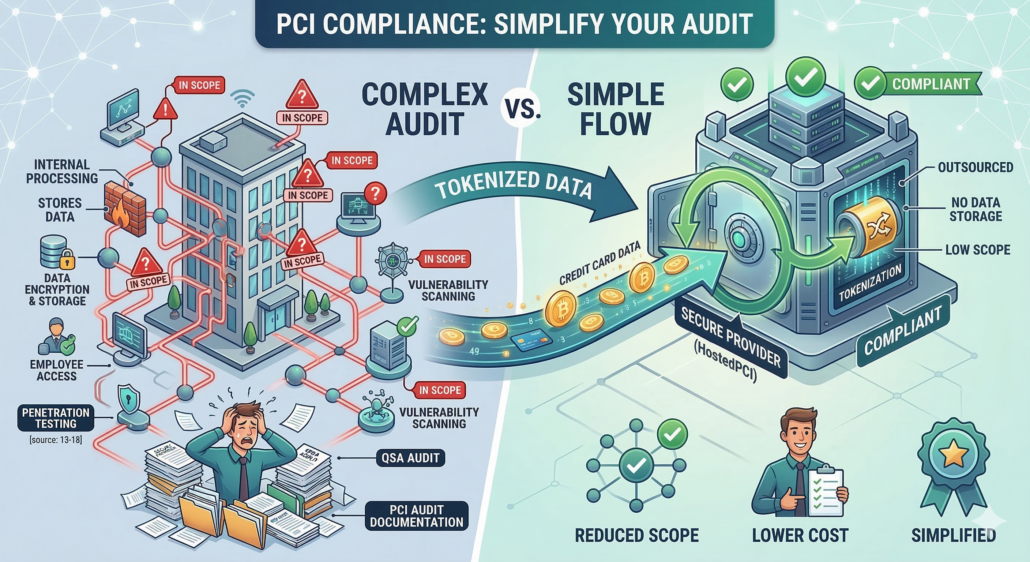
Businesses that store card data internally or allow sensitive information to pass through their infrastructure often face the most extensive audit requirements.
This can include evaluating:
- Network security architecture
- Firewalls and access controls
- Data encryption and storage practices
- Employee access permissions
- System monitoring and logging
- Vulnerability scanning and penetration testing
The more systems that interact with cardholder data, the more complex the audit becomes.
The Hidden Costs of PCI Compliance
Many merchants focus on the annual audit itself, but the real cost of PCI compliance often comes from maintaining the required security environment.
Businesses may need to implement and maintain:
- Dedicated secure networks
- Encrypted storage systems
- Continuous security monitoring tools
- Access control management
- Regular vulnerability scans and penetration tests
- Detailed documentation and policy management
In addition to technology investments, internal teams must spend significant time managing compliance requirements and preparing documentation for auditors.
For organizations that store card data directly, PCI compliance can become an ongoing operational burden.
Why Payment Data Flow Determines Audit Scope
One of the most important factors in PCI compliance is where cardholder data exists within the payment flow.
If a merchant’s systems directly capture, process, or store card numbers, those systems fall within PCI scope and must meet strict security requirements.
The broader the environment that touches cardholder data, the more extensive the audit process becomes.
Reducing PCI scope is often the most effective way for businesses to simplify compliance.
By limiting where sensitive payment data flows, merchants can dramatically reduce the number of systems that must be audited and secured.
How Outsourcing Payment Security Reduces PCI Burden
Many organizations reduce their PCI scope by using secure payment providers that handle the capture and storage of sensitive cardholder data.
Instead of collecting credit card numbers directly within their systems, merchants use secure hosted payment fields, tokenization services, or secure IVR systems that route card data directly to a compliant environment.
In this model, the merchant environment never stores or directly processes cardholder data.
Because sensitive payment data is handled outside the merchant infrastructure, the scope of the PCI audit becomes significantly smaller.
This approach can reduce both compliance costs and operational responsibilities.
How HostedPCI Helps Merchants Simplify PCI Compliance
HostedPCI provides a secure payment infrastructure designed to keep sensitive cardholder data outside the merchant environment.
Through solutions such as secure payment fields, tokenization, and IVR payment capture, card data is transmitted directly to HostedPCI’s compliant systems instead of passing through merchant networks.
This architecture allows businesses to:
- Reduce PCI audit scope
- Eliminate internal storage of cardholder data
- Simplify compliance documentation
- Lower security infrastructure costs
- Reduce internal compliance management workload
Instead of building and maintaining complex PCI-compliant systems internally, merchants can rely on HostedPCI’s secure payment environment.
This allows businesses to focus on their core operations while still maintaining strong payment security.
Lower Risk, Lower Cost, and Simpler Audits
PCI compliance will always be a requirement for businesses that accept card payments. However, the level of effort and cost required to maintain compliance can vary dramatically depending on how payment data is handled.
By removing sensitive cardholder data from internal systems, merchants can significantly reduce their compliance scope and audit complexity.
Outsourcing secure payment capture and storage to a specialized provider allows organizations to maintain strong security while avoiding the operational burden of managing PCI infrastructure internally.
For many businesses, PCI compliance audits are time-consuming, complex, and expensive. But much of that burden comes from storing or processing cardholder data within their own systems.
By redesigning payment flows so that sensitive card data is handled by secure providers, merchants can dramatically reduce PCI scope and simplify compliance.
HostedPCI helps businesses securely capture, tokenize, and store payment data while keeping sensitive information outside the merchant environment.
Organizations looking to reduce PCI audit scope and compliance costs can benefit from reviewing their payment architecture and identifying opportunities to simplify their PCI responsibilities.
Learn more at www.hostedpci.com.