
How to Accept Credit Cards Over the Phone Without PCI Scope (Call Center Guide)
Many businesses still accept credit card payments over the phone. Call centers, healthcare providers, travel companies, and subscription services rely on phone payments every day. But there is a problem that many organizations don’t realize.
If an agent hears or writes down a customer’s card number, the entire environment handling that call may fall into PCI scope. That can dramatically increase compliance requirements, security risks, and operational costs.
The good news is that there are secure ways to process payments over the phone without exposing your agents or systems to sensitive card data.
Here is what businesses need to know.
Why Taking Card Numbers Verbally Creates PCI Scope
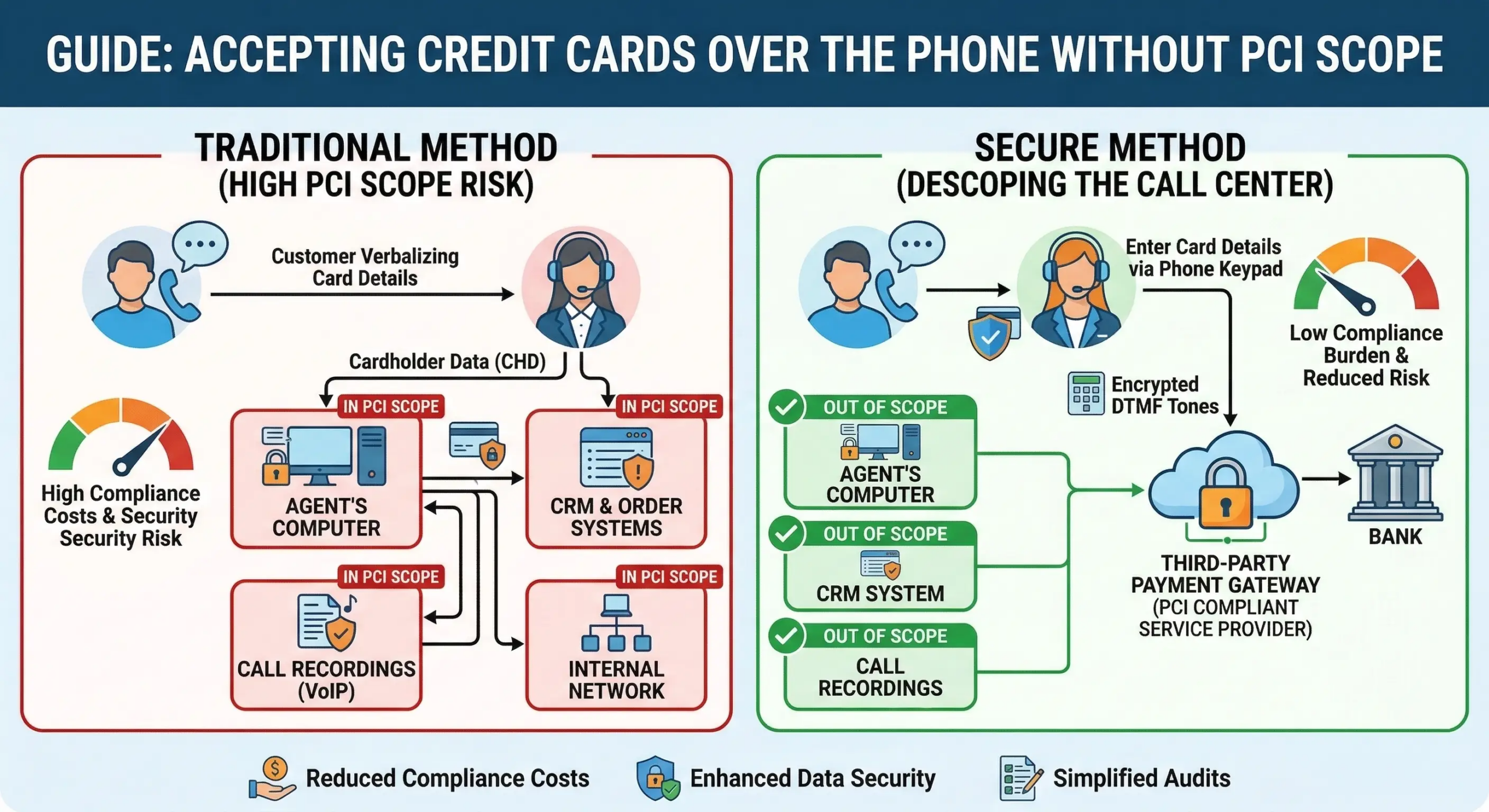
When a customer reads their credit card number to an agent, that payment data can enter multiple systems during the call.
For example:
- Call recordings may capture the card number
- Agents may enter card details into CRM systems
- Payment information may appear on agent screens
- Internal networks may transmit cardholder data
Because sensitive payment data is exposed, the entire environment involved in the call could fall under PCI DSS compliance requirements.
For many organizations, this means:
- Increased audit requirements
- Higher compliance costs
- Additional security controls
- Greater risk if data is compromised
This is why businesses are increasingly looking for ways to remove card data from the call center environment altogether.
The Risks of Storing Payment Data in CRM Systems
Many businesses unintentionally create PCI risk by storing payment details in internal systems. Agents may record card numbers in:
- CRM notes
- Order Management Systems
- Spreadsheets or Internal Tools
- Call Recordings
Even if this is done temporarily, storing card data in these systems can significantly increase compliance scope and create security vulnerabilities.
In the event of a breach, organizations may face:
- Financial Penalties
- Regulatory Consequences
- Loss of Customer Trust
Removing sensitive payment data from internal systems is one of the most effective ways to reduce risk.
How DTMF Masking and Secure IVR Remove Agents from PCI Scope
Modern payment technology allows customers to enter their card details securely during a phone call without the agent hearing or seeing the information.
This is typically done through DTMF masking and secure Interactive Voice Response (IVR) systems.
Here is how it works:
- The agent stays on the call with the customer
- The customer enters their card number using their phone keypad
- The tones are masked so the agent cannot hear the numbers
- The payment data is securely transmitted directly to the payment gateway
Because the agent never sees or hears the card data, sensitive payment information does not enter the call center environment.
This significantly reduces PCI scope and helps protect customer data.
Reduce PCI Scope While Protecting Customer Payments
If your team currently accepts credit card payments over the phone, it may be worth taking a moment to review whether your environment is unnecessarily in PCI scope.
Feel free to give us a call and walk through your payment flow with our team. We can help pinpoint where card data may be creating risk and show you where simple changes could reduce PCI scope while keeping payments secure.
HostedPCI offers a free PCI scope review for call centers, helping businesses identify potential gaps and explore safer ways to handle payments.
Learn more at www.hostedpci.com.