

Payment Gateway Failover: How to Keep Payments Running When a Provider Goes Down
A payment gateway works perfectly until it doesn’t.
An outage, maintenance window, network issue or provider failure can suddenly leave customers unable to complete transactions. For businesses processing payments at scale, even a short interruption can lead to failed checkouts, lost revenue and frustrated customers.
Having a second payment provider sounds like the obvious solution.
But there is an important difference between having a backup gateway and actually being able to fail over to it when something goes wrong.
True payment gateway failover requires the payment data, tokens, integrations and routing architecture to support the switch.
What Is Payment Gateway Failover?
Payment gateway failover is the ability to move payment processing from one provider to another when the primary route is unavailable or unable to complete the transaction.
Payment gateways and payment processors perform different roles in the transaction flow, but both can become points of dependency. In this article, payment provider is used when the same continuity principle applies to either.
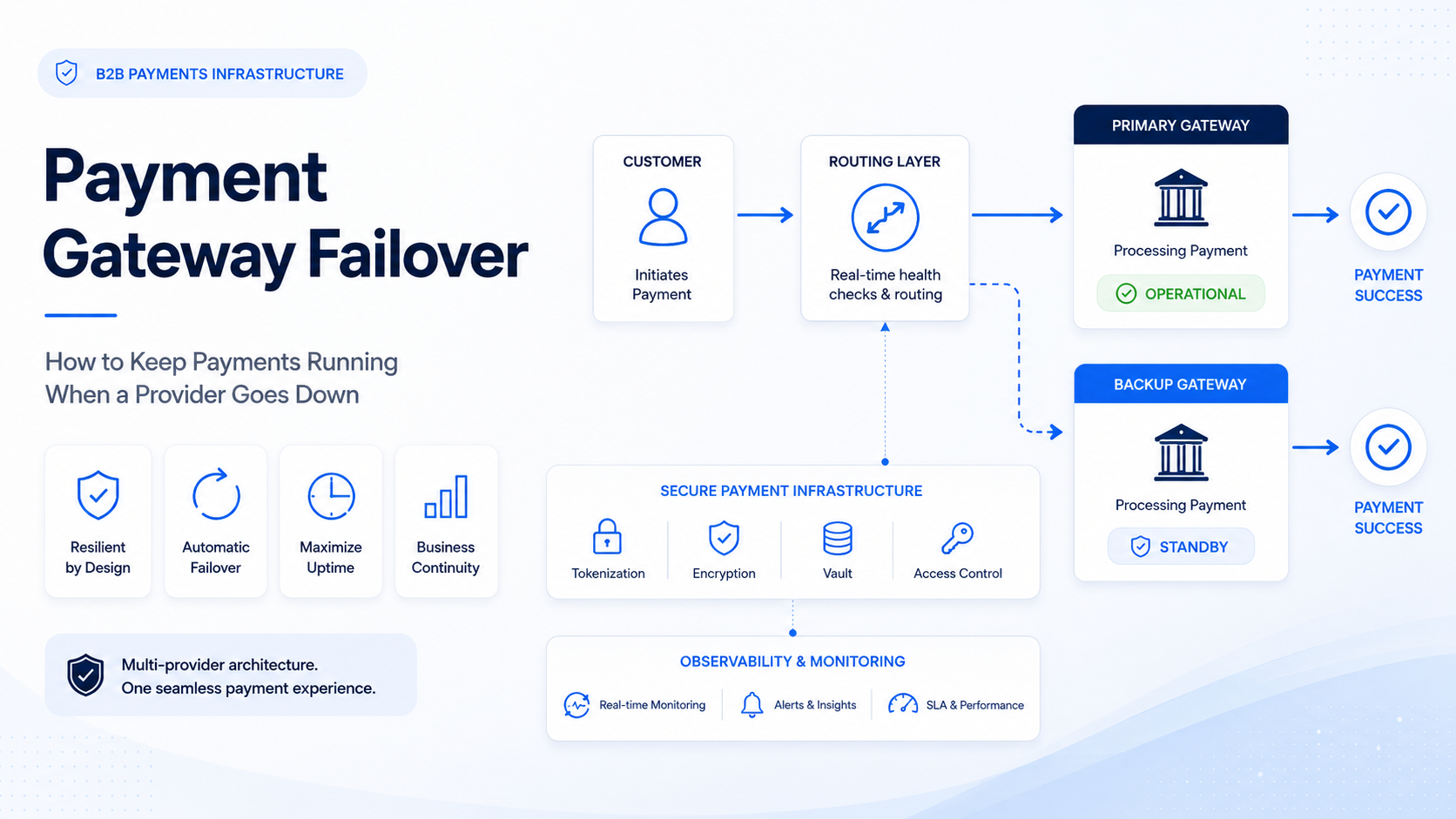
A simple architecture might look like:
Customer → Primary Gateway
A more fault-tolerant architecture provides another path:
Customer → Payment Infrastructure → Gateway A or Gateway B
The goal is not to send every declined transaction somewhere else. It is to make sure a provider-level issue does not automatically become a payment outage for your business.
HostedPCI supports connections with multiple payment gateways and processors through a normalized payment API, allowing businesses to maintain a more consistent payment layer while working with different providers.
A Backup Gateway Is Not Enough
Many businesses already have relationships with more than one payment provider.
That does not necessarily mean they are prepared for failover.
Imagine an enterprise that processes most transactions through Gateway A. It also has an account with Gateway B.
Gateway A goes down.
The obvious response is to start routing transactions to Gateway B. But then the team discovers that thousands of customer payment methods are represented by tokens created by Gateway A.
Those tokens may have no meaning to Gateway B.
The business technically has two gateways, but its stored payment credentials are still dependent on one provider.
You may be able to route new checkouts to the backup provider, but recurring payments and stored-card transactions tied to the original provider’s tokens can remain stuck.
This is why payment continuity is as much a data architecture problem as it is a gateway problem.
HostedPCI is designed so its payment tokens can be used across supported payment providers rather than forcing the merchant’s billing environment to rely only on a single provider token.
What a Strong Failover Strategy Requires
Effective payment gateway failover depends on several pieces working together.
1. Multiple Payment Providers
There needs to be another viable destination for the transaction.
Enterprises may use different providers for regions, transaction types, business units or operational requirements. A secondary provider can also serve as an alternative route when the primary provider experiences an issue.
The important point is that the backup route needs to be ready before it is needed.
2. Payment Tokens That Do Not Trap You
The token architecture matters.
If stored payment credentials only work with the primary gateway, the business may have a second processing route but still lack continuity for recurring payments and stored-card transactions.
A payment architecture that separates the merchant’s token from a single gateway gives the business more control over where transactions can be routed.
This is why token control matters long before a provider problem occurs.
3. A Routing Layer
Applications should not need a major rebuild every time a transaction is sent to a different provider.
A normalized payment layer can allow merchants to work with multiple supported gateways while keeping the application-side integration more consistent.
That separation makes provider changes easier to manage and reduces the risk of every application becoming tightly coupled to one gateway.
4. Clear Failover Rules
Not every failed payment should automatically be sent to another provider.
There is an important difference between a technical provider failure and a legitimate issuer decline.
If the gateway times out, becomes unavailable or cannot process transactions because of a technical issue, another provider may offer a valid alternate route.
If the issuer has declined the card for a legitimate reason, repeatedly sending the same transaction through different providers is not the same thing as outage failover.
A good failover strategy needs clear rules around which errors trigger another route and which do not.
The Real Test: What Happens During an Outage?
The best time to answer this question is not while your primary provider is already unavailable.
Payment teams should know in advance:
- Which provider becomes the backup?
- Can existing stored payment credentials still be used?
- Does the application need to change anything?
- Which errors trigger another route?
- How are duplicate transactions prevented?
- What happens to recurring payments?
- Can captures, refunds and other follow-up transactions still be handled correctly?
- How will the team know failover has occurred?
If answering those questions requires an emergency engineering meeting, the business probably does not have true payment failover yet.
Failover and Payment Vault Redundancy Are Different
Payment gateway failover and payment vault redundancy are related, but they solve different problems.
Payment gateway failover is about maintaining a transaction path when a processing provider becomes unavailable.
Payment vault redundancy is about maintaining secure access to stored payment credentials and tokenized data if a vault provider becomes unavailable or the business needs to migrate.
The strongest payment-continuity strategy considers both.
A business can have multiple gateways but still have a single point of dependency in its vault. It can also have redundant vaults but only one processing route.
The goal is to identify where the dependencies actually exist and design alternatives before they become operational problems.
Why Failover Matters to Revenue
Payment continuity is not only an infrastructure concern.
Consider a business processing 1,000 transactions an hour. It does not need a day-long outage for the impact to become meaningful. If its primary payment route becomes unavailable, every failed checkout represents revenue that may never be recovered.
For subscription businesses, the impact can extend beyond the incident itself if scheduled recurring payments also fail.
That makes payment failover part of a broader revenue strategy.
A strong payment architecture is designed not only to process transactions when everything is working, but also to preserve options when something stops working.
How HostedPCI Supports Multi-Provider Payment Architecture
HostedPCI sits between the merchant’s applications and supported payment gateways and processors, helping businesses securely collect, tokenize and route payment data without making their infrastructure dependent on a single provider.
Because HostedPCI tokens are designed to support multiple payment-provider relationships, enterprises can maintain greater control over stored payment credentials while changing gateways, adding providers or adjusting routing strategies.
This creates a stronger foundation for:
- Multi-gateway payment environments
- Provider redundancy
- Processor and gateway changes
- Recurring payment continuity
- Payment routing
- Reduced vendor lock-in
The objective is simple:
A provider problem should not automatically become your payment problem.
Build Failover Before You Need It
Payment outages are difficult enough without discovering that your backup provider cannot use your tokens, your applications are tightly coupled to one gateway, or your routing logic has no alternative path.
A strong payment-continuity strategy asks those questions in advance.
Businesses should know where their payment data lives, who controls their tokens, which alternative providers are available and how transactions can be redirected when something goes wrong.
Because the real question is not whether a payment provider will ever experience an outage.
It is whether your payment infrastructure is ready when it does.
Talk to HostedPCI about building a more flexible, multi-gateway payment architecture.
Learn more at www.HostedPCI.com.